Tunnel – Switching a relay depending on the astronomical clock of the MTX and according to scheduled times for special days
Scenario details: We need to switch a relay depending on the sunrise and sunset to activate a lighting system It is not possible to establish a fixed time, since the time of sunrise and sunset depends on the place (sunrise/sunset at the same time in Madrid, Barcelona or Mexico City) and day of the year […]
Tunnel – Periodic monitoring by 2G/3G/4G of 0-10V sensor. Activating the sensor supply through a digital output connected to an external relay. Send to web server through HTTP
Scenario details: We want to monitor a 0-10V sensor with a 2G/3G/4G modem The modem and the sensor will be powered by solar panels, so the 0-10V sensor that will be connected to the modem should only be activated 5 seconds before the measurement (to activate an external relay that supplies the sensor and this […]
Tunnel – Opening of a mechanical door by a missed call from an authorized phone number
Scenario details: We have the mechanical door of a garage that now opens using a push button We also want to be able to open the door by making a missed call. To do so, when making a missed call, the relay must be switched on for a couple of seconds. That relay will be connected, in […]
Tunnel – Reading meter boxes via 3G in scenarios with an already installed modem that can’t be disconnected (the current modem must be kept)
Scenario details: We want to read an electric meter box every 10 minutes. Since the frequency is high, we’ll access the meter box via GPRS/3G instead of with GSM calls to reduce costs Simultaneously, the electric company will make a daily conventional GSM data pone call to read the meter box In this scenario there’s […]
Tunnel – Example of reading of pulse counters (dry contact or reed). Sending data to web platform
Scenario details: Every water meters in a multiple-site installation has a pulse output. At every site there are 2 counters in need of a modem capable of carrying out pulse counting of each counter Every hour the modem must send counter data to a WEB platform to be dealt with Solution: MTX-Tunnel firmware + MTX-Java-IoT/MTX-Java-T/MTX-Java-T2 EXAMPLE of configuration (config.txt […]
Tunnel – Example of meter reading via IP connection for real-time readings and for Energy operator. Preference for Energy operator’s IP connection
Scenario details: We need to read an energy meter, periodically, every 10 minutes through a 3G-RS232 gateway. We will call it “Real-Time” connection In parallel, an energy operator (like Endesa, Iberdrola, …) once a day will establish a IP connection (i.e., a 3G-RS232 gateway AS WELL, NOT A GSM CALL) to carry out the daily meter reading Operator’s […]
Tunnel – An advanced example for reading 2 serial devices using a single modem/SIM and simultaneously using GPRS connection and GSM calls. There is additional serial tunnelling when there are no GSM/GPRS connections
Scenario details: In this scenario you have a modem with 2 serial ports. One serial port is connected to an energy meter; the other is connected to a PLC When there is no GPRS connection with the modem and a GSM call has not been established by the operator, the modem acts as a serial tunnel. This […]
Tunnel – A basic example for meter reading with simultaneous GPRS connections and GSM calls
Scenario details: The intention is to take electrical meter readings periodically, every 10 minutes. By obtaining readings so frequently you will access the meter via GPRS instead of with GSM calls in order to save costs At the same time, the energy operator (Endesa, Iberdrola, etc.) will obtain a reading once a day with a conventional GSM call […]
Tunnel – Reading and sending Modbus registries periodically from a PLC to an FTP server
Scenario details: We have a PLC Modbus RTU. This PLC has a series of variables/registries (for instance, temperature and 3 meter boxes) inside its internal memory, which need to be read and sent periodically to an FTP server That is why the MTX-Tunnel needs to ask the PLC to read said registries every 15 minutes via a […]
Tunnel – Providing IP to Master Modbus RTU and Modbus RTU slaves
Scenario details: We have a PLC with Modbus RTU RS485 communications which, acting as master, performs periodic readings of 3 slave devices also with Modbus RTU RS485 communications It is necessary to replicate that same scenario, with the same RS485 devices, but with IP communications, since it is not possible to carry out a wiring […]
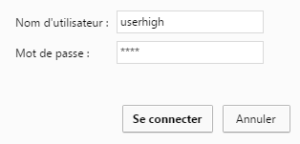
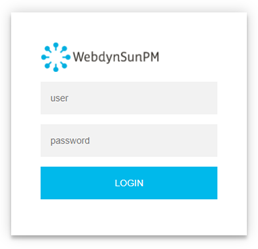 Les accès par défaut sont :
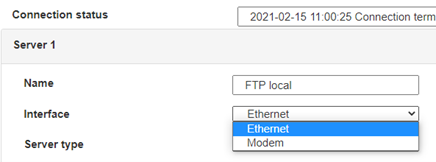
 Saisir le mode de connexion « Ethernet » ou « modem » :
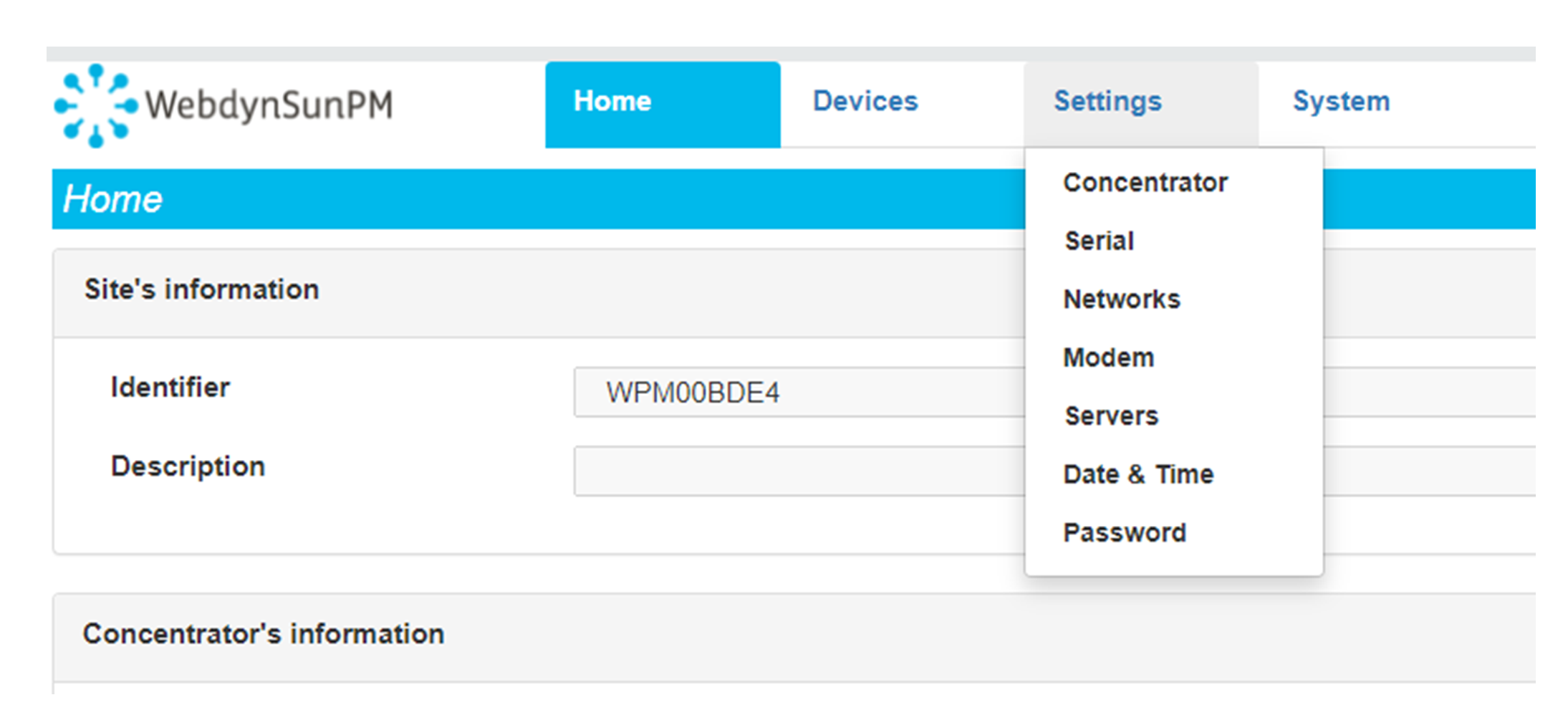
 Dans le cas d’une configuration par Ethernet, veiller à ce que les paramètres IP soient compatibles avec l’accès au serveur d’après la configuration du réseau local du concentrateur. Dans le cas d’une connexion par Ethernet, la configuration doit être compatible avec la topologie du réseau local du concentrateur afin qu’il puisse accéder aux serveurs. Cette configuration se fait via la page de configuration « Networks » (voir chapitre 3.2.2.3 : « Réseaux (Networks) »).
Dans le cas d’une connexion par modem, la configuration du modem doit être correcte avant de pouvoir effectuer une connexion. Cette configuration se fait dans la page de configuration « Modem » (voir chapitre 3.2.2.4 : « Modem »).
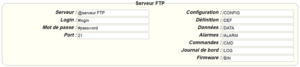
Les paramètres des serveurs à configurer au minimum sont les suivants :
Dans le cas d’une configuration par Ethernet, veiller à ce que les paramètres IP soient compatibles avec l’accès au serveur d’après la configuration du réseau local du concentrateur. Dans le cas d’une connexion par Ethernet, la configuration doit être compatible avec la topologie du réseau local du concentrateur afin qu’il puisse accéder aux serveurs. Cette configuration se fait via la page de configuration « Networks » (voir chapitre 3.2.2.3 : « Réseaux (Networks) »).
Dans le cas d’une connexion par modem, la configuration du modem doit être correcte avant de pouvoir effectuer une connexion. Cette configuration se fait dans la page de configuration « Modem » (voir chapitre 3.2.2.4 : « Modem »).
Les paramètres des serveurs à configurer au minimum sont les suivants :
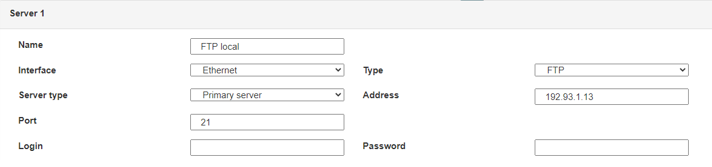 Il faut donc configurer les champs : « Interface », « Type », « Server type », « Address », « Port », « Login » et « Password ».
Les autres champs peuvent être laissés aux valeurs par défaut à condition que les répertoires aient été créés correctement auparavant. Voir chapitre 3.1.2 : « Fichiers de configuration » pour plus de détails.
Il faut donc configurer les champs : « Interface », « Type », « Server type », « Address », « Port », « Login » et « Password ».
Les autres champs peuvent être laissés aux valeurs par défaut à condition que les répertoires aient été créés correctement auparavant. Voir chapitre 3.1.2 : « Fichiers de configuration » pour plus de détails.




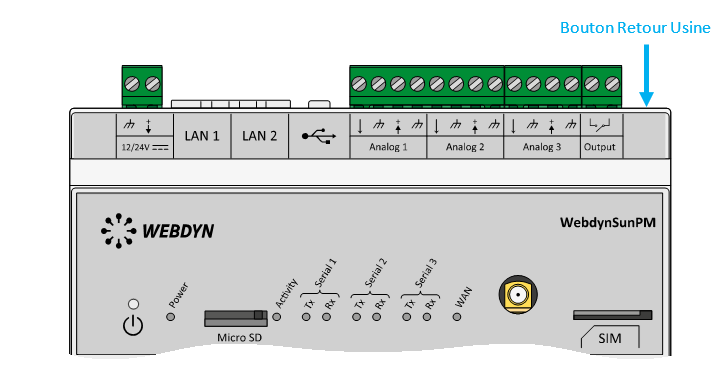 Attendre. Le concentrateur va redémarrer avec sa configuration usine.