Suchen Sie etwas anderes?
Table of Contents
Wireless Status
MAC Address: MAC address of wireless client.
Radio: Display whether radio is on or not.
Mode: Wireless mode.
Network: Wireless network mode.
SSID: Wireless network name.
Channel: Wireless network channel.
TX Power: Reflection power of wireless network.
Rate: Reflection rate of wireless network.
Encryption-Interface wl0: Enable or disable Encryption-Interface wl0.

Received (RX): received data packet.
Transmitted (TX): transmitted data packet.

MAC Address: MAC address of wireless client.
Interface: Interface of wireless client.
Uptime: Uptime of wireless client.
TX Rate: Transmit rate of wireless client.
RX Rate: Receive rate of wireless client.
Signal: The signal of wireless client.
Noise: The noise of wireless client.
SNR: The signal to noise ratio of wireless client.
Signal Quality: Signal quality of wireless client.


Enter the “ethernet” or “modem” connection type:
For an ethernet configuration, make sure the IP parameters are compatible with server access according to the concentrator local network configuration. For an ethernet connection, the configuration must be compatible with the concentrator’s local network topology so that it can access the servers. This configuration is done from the “Networks” configuration page (see section 3.2.2.3: “Networks”).
For a modem connection, the modem configuration must be correct before a connection can be set up. This configuration is done from the “Modem” configuration page (see section 3.2.2.4: “Modem”).
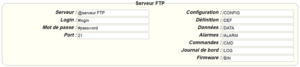
The parameters for the servers to be configured are at least the following:
Therefore the following fields need to be configured: “Interface”, “Type”, “Server type”, “Address”, “Port”, “Login” and “Password”.
The other fields can be left at the default values subject to the directories having been properly created beforehand. See section 3.1.2: “Configuration files” for more details.

Wait. The concentrator will reboot using its factory configuration.