Tunnel – Sending digital and analog input value telemetry by 2G/3G/4G according to an event (not periodically) using ultra low power modem. Sending to MQTT broker
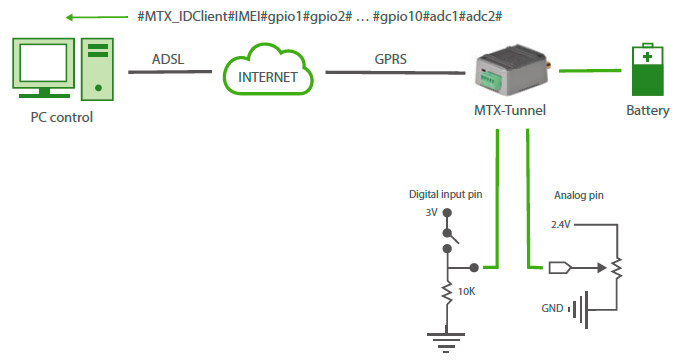
Some digital and analog inputs need to be remotely monitored via GPRS
MTX-65-ULP is powered by external batteries and remains in Low Power Mode (2 uA) until the level of digital inputs change (tamper)
When there is a change in tamper digital input level, the modem wakes up and changes to normal operation mode to read the digital and analog inputs. Those levels are sent to a server using GPRS via a TCP/IP socket
After the information has been sent, the modem goes back into ultra low power mode again
GPRS APN from your network operator GPRS Login GPRS Password Google DNS. Must be used if TCP_IP is set to DNS Connected data while ULP is awake MTX terminal modem model used We don’t use gateways Modem ULP service activated Modem will be awake Indefinitely asleep until tamper input changes Awake during 1 minutes MQTT service in the modem activated Broker IP/DNS, including port Identifier MTX-Tunnel subscribes to this topic for commands Service quality Keep alive MQTT connection (300 seconds) We don’t need persistence Sending status data activated MQTT sending mode Topic where status data will be sent Sending extended data (E/S, ADCs, etc.) Every 120 seconds data is sent
Where IMEI: the unique identification number of the modem TYPE: JSON type (IOS in this case) TS: TimeStamp (modem time when the event happened) IP: modem IP address CSQ: modem coverage (0 … 31) TECH: technology used in that moment (2G/3G/4G) VER: MTX-Tunnel firmware version MOD: MTX model (field MTX_model) VCC: MTX supply voltage (in millivolts) IOx: digital input x value AD1: analog input 1 value AD2: analog input 2 value CO1: pulse counter 1 value CO2: pulse counter 2 value CO3: pulse counter 3 value CID: cell ID of the telephone station used
The ULP_minutesOff parameter is the amount of time that MTX-Tunnel is in low power mode (sleep) starting just after the modems go back into low power mode
You can finish the ULP session at any time (without waiting 2 minutes). To do that you can send the model (to the topic [IMEI]/AT1) the command AT^MTXTUNNEL=SETULPSECONDS,0
Modem sends JSON witg time. There isn’t time synch, so the time received can be innacurate. Since data is sent in real time, it can take the time from its own data reception server
Avete una domanda? Avete bisogno di un preventivo? Contattateci.
Appendices and other documents
Important information
SMS encryption tool (new WebdynSunPM devices will only accept encrypted SMS commands)
No, the concentrator is not able to decrypt data from WM-BUS equipment because it does not have a safe on board to guarantee the security of the encryption keys of your equipment. The recovered data is deposited without modification (without decryption) by the concentrator on your remote server.
the battery level: if the battery level is too low or empty, the product will not run properly or not run at all.
Modem reception level: a bad signal at the modem may also prevent the hub from uploading files. Look to move the product or install an external antenna to improve signal quality.
The last configuration file: a bad configuration file can block the product.
Replace the product and inject the configuration from the old product into the new one. If a white list is used, remember to inject it into the new product as well.
Warning – Firmware update V4.07.02 –For the old version with SIM CARD of the pin code is 0000 you can update in this version.
For the second case : When you insert a SIM CARD with pin code is 0000 used in this version (4.07.02) Downgrading to a previous version is not permitted.
There are two types of configuration: via the web interface or via SMS.
Configuration of the web interface:
1/ Go to the configuration page with the gateway IP address (default 192.168.1.12)
2/ Go to the Configuration tab.
3/ Select either the Ethernet or modem connection mode:
If connecting via the local network (Ethernet):
Edit the WebdynSun’s IP parameters by assigning it a network-compatible address.
Please note, all fields must be completed in accordance with the configuration of your local network.
If connecting via the GPRS network (Modem):
Change the connection settings of the GPRS modem to the settings provided by your mobile operator.
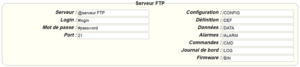
4/ Edit the FTP server parameters.
5/ Confirm the changes.
6/ Restart the WebdynSun gateway using the new settings.
7/ In the menu, click on the “installation” tab, followed by the “connection” sub-tab and start the connection.
Configuration via SMS:
This configuration method requires the use of an active SIM card with a data option and a pin code that must be either “0000” or disabled. The SIM card must be inserted into the unit before connection to the mains supply. After connection to the mains supply, send the following SMS messages to the number of the previously inserted SIM card:
SMS for configuring the APN: After replacing the generic fields with those of your operator, send the following SMS*: apn=apn_name;usr=user_name;pwd=password;
Replace the above SMS fields with the following information:
apn_name: APN name supplied by your mobile operator
user_name: APN ID supplied by your mobile operator
password: APN password supplied by your mobile operator
SMS for FTP configuration: After replacing the generic fields with those of your FTP server, send the following SMS*: Ftp=server_name:user_name:password:port;
Replace the above SMS fields with the following information:
server_name: FTP server address
user_name: FTP account ID
Password: FTP account password
Port: FTP server port (the default port is 21)
Connection SMS:
Send the word “connect” by SMS* to launch a connection to the FTP server
*Please note: the formatting of the SMS must be exactly identical to that shown above (e.g.: no spaces between characters, etc.)
Put the DIP Switch 2 on the WebdynSun card in “ON” position
Start the WebdynSun by connecting it only to the mains power supply
Wait until all the LEDs flash and then stop flashing (3 to 5 mins).
Disconnect from the mains
Reset the Dip Switch 2 to “OFF”
Reconnect the battery
Reconnect to the mains supply and the WebdynSun starts normally.
If there is a SIM card inserted in the unit:
Send an SMS message containing the word “factory” to the number of the inserted SIM card.
NB : Resetting the gateway restores the configuration to its original state. Please note: data will be saved but the specific settings will not. Therefore, all the settings must be reconfigured.
Therefore, if the remote server cannot be accessed, the WebdynSun gateway can backup data for several months. The maximum data backup time varies depending on the amount of data to be collected.
The average backup time ranges from 3 to 4 months.
Yes, data may be sent to a PLC if the latter is equipped with a Modbus protocol. The “Report” configuration file allows the WebdynSun gateway to automatically write the values read on a Modbus slave
Different brands of inverter may be connected to the RS485(B) port or via the Ethernet port if the inverter protocol is based on the Modbus protocol (RTU or TCP).
However, different brands of inverters cannot be connected to the same RS485(A) port.
Yes, different Modbus devices can be connected to the same RS485 (B) port.
However, they must have the same communication parameters (bus parameters or compatible IP parameters), in order for them to communicate with each other.
Warning – Firmware update V4.07.02 –For the old version with SIM CARD of the pin code is 0000 you can update in this version. For the second case : When you insert a SIM CARD with pin code is 0000 used in this version (4.07.02) Downgrading to a previous version is not permitted.
Warning – Firmware update V4.07.02 – For the old version with SIM CARD of the pin code is 0000 you can update in this version.
For the second case : When you insert a SIM CARD with pin code is 0000 used in this version (4.07.02) Downgrading to a previous version is not permitted.
En caso de que el archivo se elimine de la carpeta después de conectar el concentrador WebdynRF, el problema suele deberse a un error de formato de archivo. Los archivos de configuración y comando deben respetar el formato descrito en los archivos de esquema (XSD).
Para comprobar la coherencia de un esquema, abra el archivo XML con el editor de texto Notepad++ e instale el complemento «XML Tool». Luego copie el archivo XSD correspondiente al archivo XML en la misma carpeta y seleccione en XML Tool «Validate now». Deben mostrarse los errores detectados por la herramienta.
En caso de que el archivo no se elimine del servidor, el problema más común es que el archivo no se ha guardado en la ubicación correcta. El archivo debe estar disponible en el servidor en la carpeta «INBOX», y en la subcarpeta que lleva el nombre del identificador único (UID) del producto (ejemplo «/INBOX/0045CE/»).
Hay 2 modos de actualización de firmware:
Actualización local:
En la interfaz de configuración de la WebdynRF, acceda a la pestaña «Actions» y seleccione el actualizador en el menú «File upload» antes de hacer clic en el botón «Upload».
Actualización remota:
Descargue del servidor FTP el archivo que contiene el actualizador (archivo con la extensión «.bz2») en la carpeta «BIN». Luego inserte el comando de actualización en la carpeta INBOX correspondiente a su concentrador («INBOX/», con el identificador del concentrador respectivo)
El comando de actualización debe respetar el siguiente formato:
updater.tar.bz2
checksum_md5
updater.tar.bz2
checksum_md5
Con :
updater.tar.bz2: Nombre del archivo de actualización descargado en la carpeta «BIN»
checksum_md5: Código md5 del archivo de actualización
La falta de conexión con el servidor FTP puede explicarse por un problema de conexión a la red (Ethernet o GPRS), por un problema de inicio de sesión FTP o por una no activación de la conexión.
En caso de problema de conexión a la red, verifique los puntos siguientes:
Ethernet:
Modo del módem en «off» o «alwaysoff»
Campos «Gateway» introducidos correctamente
Debe configurarse al menos un servidor DNS
GPRS:
Modo del módem en «on»
APN, identificador APN y contraseña APN introducidos correctamente
Número de llamada GPRS a «* 99***1#»
En caso de problema de inicio de sesión, verifique los puntos siguientes:
Parámetros FTP incorrectos
Puerto TCP 21 cerrado en salida
Problema de resolución del nombre de dominio: no se ha indicado el servidor DNS
En caso de que no se active la conexión:
En este caso, solo la conexión automática no funciona. El problema suele deberse a una configuración incorrecta de los «schedules». Atención: el ID de los schedules debe ser un número entero.
USO PARTICULAR DE LA PASARELA WEBDYNRF WIRELESS M-BUS
Para que se carguen los datos de los módulos WM-bus, es necesario
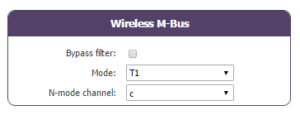
Elegir el modo correspondiente a los módulos utilizados (S, T o N)
Definir los módulos o grupos de módulos a tratar
Un módulo puede definirse de forma única por todos los campos siguientes:
Id
Manufacturer
Version
Medium
Si los datos de un módulo estuviesen encriptados, es posible definir la clave de encriptado de este módulo en el campo «Key».
Para simplificar la introducción de los módulos a tratar, es posible definir un grupo de módulos respetando los campos introducidos. Los otros campos se dejarán vacíos (a continuación se muestra un ejemplo de configuración que permite recuperar todos los módulos del manufacturer Webdyn (WDN) con la clave de encriptado «00000000000000000000000000000000».
Id :
Manufacturer : WDN
Medium :
Version :
Label : Webdyn
Key : 00000000000000000000000000000000
Nota: Para que se tengan en cuenta los módulos (filtros) introducidos, el modo «ByPass filter» debe estar desactivado.
Los estados cargados por el concentrador WebdynRF son los valores brutos contenidos en los módulos Wavenis. Se cargan sin interpretación. Para obtener más detalles, consulte los manuales de los módulos Coronis.
Wenn die Datei nach dem Verbinden des WebdynRF-Hubs aus dem Verzeichnis entfernt wird, liegt das Problem in der Regel an einem Fehler im Dateiformat. Die Konfigurations- und Befehlsdateien müssen das in den Schemadateien (XSD) beschriebene Format erfüllen.
Um die Konsistenz eines Schemas zu überprüfen, öffnen Sie die XML-Datei mit dem Editor Notepad++ und installieren Sie das Add-in „XML Tool“. Kopieren Sie dann die XSD-Datei, die der XML-Datei entspricht, in dasselbe Verzeichnis, und wählen Sie im XML-Tool „Validate now“ (Jetzt bestätigen) aus. Die vom Tool erkannten Fehler müssen angezeigt werden.
Wenn die Datei nicht vom Server gelöscht wird, besteht das Problem meist darin, dass die Datei nicht an der richtigen Stelle abgelegt wurde. Die Datei muss auf dem Server im Verzeichnis „INBOX“ und im Unterverzeichnis mit dem Namen der Produkt-UID verfügbar sein (Beispiel: „/INBOX/0045CE/“).
Es gibt 2 Modi für die Aktualisierung der Firmware:
Die lokale Aktualisierung: Wechseln Sie auf der WebdynRF-Konfigurationsschnittstelle zur Registerkarte „Actions“ (Aktionen) und wählen Sie im Menü „File upload“ (Datei-Upload) den Updater aus, bevor Sie auf die Schaltfläche „Upload“ (Aktualisieren) klicken
Die Remote-Aktualisierung: Laden Sie die Datei, die den Updater enthält (Datei mit der Erweiterung „.bz2“), auf den FTP-Server in das Verzeichnis „BIN“ hoch. Geben Sie dann den Aktualisierungsbefehl in das INBOX-Verzeichnis für Ihren Hub („INBOX/“ mit dem Benutzernamen des betreffenden Hubs).
Der Aktualisierungsbefehl muss folgendem Format entsprechen:
updater.tar.bz2 checksum_md5
updater.tar.bz2 checksum_md5
Mit :
updater.tar.bz2: Name der Updater-Datei, die in das Verzeichnis „BIN“ geladen wurde
Eine fehlende Verbindung zum FTP-Server kann durch ein Problem mit der Netzwerkverbindung (Ethernet oder GPRS), ein Problem mit der FTP-Anmeldung oder durch die Nichtauslösung der Verbindung verursacht werden.
Falls Probleme mit der Netzwerkverbindung auftreten, überprüfen Sie Folgendes:
Ethernet:
Modem-Modus auf „off“ oder „alwaysoff“
„Gateway“-Feld korrekt eingegeben
Es muss mindestens ein DNS-Server konfiguriert sein
GPRS:
Modem-Modus auf „on“
APN, APN-Benutzername und APN-Passwort korrekt eingegeben
GPRS-Rufnummer auf „*99“ *1#“
Falls Probleme bei der Anmeldung auftreten, überprüfen Sie Folgendes:
Falsche FTP-Einstellungen
TCP-Port 21 geschlossen bei Ausgang
Problem bei der Auflösung des Domain-Namens: Der DNS-Server ist nicht näher spezifiziert
Bei Nichtauslösung der Verbindung:
In diesem Fall funktioniert nur die automatische Anmeldung nicht. Das Problem ist in der Regel auf eine schlechte Konfiguration der Zeitpläne zurückzuführen. Achtung, die ID der Zeitpläne muss eine Ganzzahl sein.
BESONDERE VERWENDUNG DES WEBDYNRF WIRELESS M-BUS-GATEWAYS
Für die Eskalation der Daten der WM-Bus-Module gehen Sie wie folgt vor:
Wählen Sie den Modus aus, der den verwendeten Modulen entspricht (S, T oder N)
Definieren Sie die Module oder Modulgruppen, die verarbeitet werden sollen
Ein Modul kann durch alle folgenden Felder eindeutig definiert werden:
Id
Manufacturer (Hersteller)
Version
Medium
Falls die Daten eines Moduls verschlüsselt werden, kann der Verschlüsselungsschlüssel für dieses Modul im Feld „Schlüssel“ festgelegt werden.
Um die Eingabe der zu verarbeitenden Module zu vereinfachen, kann eine Modulgruppe definiert werden, die die eingegebenen Felder erfüllt. Die anderen Felder bleiben dann leer (nachfolgend ein Beispiel für eine Konfiguration, mit der alle Module des Herstellers Webdyn (WDN) mit Verschlüsselungsschlüssel „00000000000000000000000000000000“ abgerufen werden können.)
Id :
Manufacturer (Hersteller): WDN
Medium :
Version :
Label : Webdyn
Key : 00000000000000000000000000000000
Hinweis: Damit die eingegebenen Module (Filter) berücksichtigt werden können, muss der Modus „Bypass filter“ (Bypass-Filter) deaktiviert werden.
Die Status, die vom WebdynRF-Hub eskaliert werden, sind die Rohwerte, die in den Wavenis-Modulen enthalten sind. Sie werden ohne Interpretation eskaliert. Weitere Informationen finden Sie in den Handbüchern der Coronis-Module.
If the file is deleted from the directory after connecting the WebdynRF gateway, the problem is usually due to a file format error. The configuration and control files must follow the format described in the schema (XSD) files.
To check schema consistency, open the XML file with the Notepad++ text editor and install the “XML Tool” add-on. Next, copy the corresponding XSD file to the XML file in the same directory, and select “Validate now” in XML Tool. Errors detected by the tool should be displayed.
If the file is not deleted from the server, the most common problem is that the file has not been located correctly. The file must be available on the server in the “INBOX” directory and in the sub-directory bearing the product UID name (e.g.: “/INBOX/0045CE/”).
There are 2 firmware updating methods: Local updating: On the WebdynRF configuration interface, go to the “Actions” tab and select the updater in the “File upload” menu before clicking on the “Upload” button
Remote updating: Upload the file containing the updater (file with extension “.bz2”) in the “BIN” directory to the FTP server . Next, place the update command in the INBOX directory corresponding to your gateway (“INBOX/”, with, the identifier of the gateway concerned)
The update command must follow the following format:
updater.tar.bz2 checksum_md5
updater.tar.bz2 checksum_md5
With:
updater.tar.bz2: Updater file name uploaded to the “BIN” directory
A lack of connection to the FTP server may be due to a network connection problem (Ethernet or GPRS), an FTP login problem or a failure to initiate the connection.
If you cannot connect to the network, check the following points:
Ethernet:
Modem set to “off” or “always off”
“Gateway” fields correctly entered
At least one DNS server must be configured
GPRS:
Modem set to “on”
APN, APN ID and APN password correctly entered
GPRS call number set to “*99***1#”
If you cannot log in, check the following points:
Incorrect FTP parameters
TCP port 21 closed at output
Domain name resolution problem: the DNS server is not specified
If the connection fails to initiate:
In this case, only the automatic connection does not work. The problem is probably caused by an incorrect schedule configuration. Please note, the schedule ID must be an integer.
PARTICULAR APPLICATION OF THE WEBDYNRF WIRELESS M-BUS GATEWAY
For the WM-bus module data to be transmitted, you must:
Choose the mode corresponding to the modules used (S, T or N)
Define the modules or groups of modules to be processed
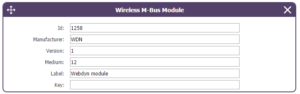
A module may be defined in a unique way by all the fields below:
Id
Manufacturer
Version
Medium
If a module’s data is encrypted, the encryption key for this module can be defined in the “Key” field.
To simplify the entry of the modules to be processed, a module group can be defined that conforms to the fields entered. The other fields will then be left empty (below is an example of a configuration for retrieving all Webdyn manufacturer (WDN) modules with the encryption key “00000000000000000000000000000000”.
Id :
Manufacturer : WDN
Medium :
Version :
Label : Webdyn
Key : 00000000000000000000000000000000
Note: In order for the modules (filters) entered to be taken into account, the “ByPass filter” mode must be deactivated.
The statuses transmitted by the WebdynRF gateway are the raw values contained in the Wavenis modules. They are transmitted without interpretation. For further details, please refer to the Coronis module manuals.
En caso de que el archivo se elimine de la carpeta después de conectar el concentrador WebdynRF, el problema suele deberse a un error de formato de archivo. Los archivos de configuración y comando deben respetar el formato descrito en los archivos de esquema (XSD).
Para comprobar la coherencia de un esquema, abra el archivo XML con el editor de texto Notepad++ e instale el complemento «XML Tool». Luego copie el archivo XSD correspondiente al archivo XML en la misma carpeta y seleccione en XML Tool «Validate now». Deben mostrarse los errores detectados por la herramienta.
En caso de que el archivo no se elimine del servidor, el problema más común es que el archivo no se ha guardado en la ubicación correcta. El archivo debe estar disponible en el servidor en la carpeta «INBOX», y en la subcarpeta que lleva el nombre del identificador único (UID) del producto (ejemplo «/INBOX/0045CE/»).
Hay 2 modos de actualización de firmware:
Actualización local:
En la interfaz de configuración de la WebdynRF, acceda a la pestaña «Actions» y seleccione el actualizador en el menú «File upload» antes de hacer clic en el botón «Upload».
Actualización remota:
Descargue del servidor FTP el archivo que contiene el actualizador (archivo con la extensión «.bz2») en la carpeta «BIN». Luego inserte el comando de actualización en la carpeta INBOX correspondiente a su concentrador («INBOX/», con el identificador del concentrador respectivo)
El comando de actualización debe respetar el siguiente formato:
updater.tar.bz2
checksum_md5
updater.tar.bz2
checksum_md5
Con :
updater.tar.bz2: Nombre del archivo de actualización descargado en la carpeta «BIN»
checksum_md5: Código md5 del archivo de actualización
La falta de conexión con el servidor FTP puede explicarse por un problema de conexión a la red (Ethernet o GPRS), por un problema de inicio de sesión FTP o por una no activación de la conexión.
En caso de problema de conexión a la red, verifique los puntos siguientes:
Ethernet:
Modo del módem en «off» o «alwaysoff»
Campos «Gateway» introducidos correctamente
Debe configurarse al menos un servidor DNS
GPRS:
Modo del módem en «on»
APN, identificador APN y contraseña APN introducidos correctamente
Número de llamada GPRS a «* 99***1#»
En caso de problema de inicio de sesión, verifique los puntos siguientes:
Parámetros FTP incorrectos
Puerto TCP 21 cerrado en salida
Problema de resolución del nombre de dominio: no se ha indicado el servidor DNS
En caso de que no se active la conexión:
En este caso, solo la conexión automática no funciona. El problema suele deberse a una configuración incorrecta de los «schedules». Atención: el ID de los schedules debe ser un número entero.
USO PARTICULAR DE LA PASARELA WEBDYNRF WIRELESS M-BUS
Para que se carguen los datos de los módulos WM-bus, es necesario
Elegir el modo correspondiente a los módulos utilizados (S, T o N)
Definir los módulos o grupos de módulos a tratar
Un módulo puede definirse de forma única por todos los campos siguientes:
Id
Manufacturer
Version
Medium
Si los datos de un módulo estuviesen encriptados, es posible definir la clave de encriptado de este módulo en el campo «Key».
Para simplificar la introducción de los módulos a tratar, es posible definir un grupo de módulos respetando los campos introducidos. Los otros campos se dejarán vacíos (a continuación se muestra un ejemplo de configuración que permite recuperar todos los módulos del manufacturer Webdyn (WDN) con la clave de encriptado «00000000000000000000000000000000».
Id :
Manufacturer : WDN
Medium :
Version :
Label : Webdyn
Key : 00000000000000000000000000000000
Nota: Para que se tengan en cuenta los módulos (filtros) introducidos, el modo «ByPass filter» debe estar desactivado.
Los estados cargados por el concentrador WebdynRF son los valores brutos contenidos en los módulos Wavenis. Se cargan sin interpretación. Para obtener más detalles, consulte los manuales de los módulos Coronis.
Wenn die Datei nach dem Verbinden des WebdynRF-Hubs aus dem Verzeichnis entfernt wird, liegt das Problem in der Regel an einem Fehler im Dateiformat. Die Konfigurations- und Befehlsdateien müssen das in den Schemadateien (XSD) beschriebene Format erfüllen.
Um die Konsistenz eines Schemas zu überprüfen, öffnen Sie die XML-Datei mit dem Editor Notepad++ und installieren Sie das Add-in „XML Tool“. Kopieren Sie dann die XSD-Datei, die der XML-Datei entspricht, in dasselbe Verzeichnis, und wählen Sie im XML-Tool „Validate now“ (Jetzt bestätigen) aus. Die vom Tool erkannten Fehler müssen angezeigt werden.
Wenn die Datei nicht vom Server gelöscht wird, besteht das Problem meist darin, dass die Datei nicht an der richtigen Stelle abgelegt wurde. Die Datei muss auf dem Server im Verzeichnis „INBOX“ und im Unterverzeichnis mit dem Namen der Produkt-UID verfügbar sein (Beispiel: „/INBOX/0045CE/“).
Es gibt 2 Modi für die Aktualisierung der Firmware:
Die lokale Aktualisierung: Wechseln Sie auf der WebdynRF-Konfigurationsschnittstelle zur Registerkarte „Actions“ (Aktionen) und wählen Sie im Menü „File upload“ (Datei-Upload) den Updater aus, bevor Sie auf die Schaltfläche „Upload“ (Aktualisieren) klicken
Die Remote-Aktualisierung: Laden Sie die Datei, die den Updater enthält (Datei mit der Erweiterung „.bz2“), auf den FTP-Server in das Verzeichnis „BIN“ hoch. Geben Sie dann den Aktualisierungsbefehl in das INBOX-Verzeichnis für Ihren Hub („INBOX/“ mit dem Benutzernamen des betreffenden Hubs).
Der Aktualisierungsbefehl muss folgendem Format entsprechen:
updater.tar.bz2 checksum_md5
updater.tar.bz2 checksum_md5
Mit :
updater.tar.bz2: Name der Updater-Datei, die in das Verzeichnis „BIN“ geladen wurde
Eine fehlende Verbindung zum FTP-Server kann durch ein Problem mit der Netzwerkverbindung (Ethernet oder GPRS), ein Problem mit der FTP-Anmeldung oder durch die Nichtauslösung der Verbindung verursacht werden.
Falls Probleme mit der Netzwerkverbindung auftreten, überprüfen Sie Folgendes:
Ethernet:
Modem-Modus auf „off“ oder „alwaysoff“
„Gateway“-Feld korrekt eingegeben
Es muss mindestens ein DNS-Server konfiguriert sein
GPRS:
Modem-Modus auf „on“
APN, APN-Benutzername und APN-Passwort korrekt eingegeben
GPRS-Rufnummer auf „*99“ *1#“
Falls Probleme bei der Anmeldung auftreten, überprüfen Sie Folgendes:
Falsche FTP-Einstellungen
TCP-Port 21 geschlossen bei Ausgang
Problem bei der Auflösung des Domain-Namens: Der DNS-Server ist nicht näher spezifiziert
Bei Nichtauslösung der Verbindung:
In diesem Fall funktioniert nur die automatische Anmeldung nicht. Das Problem ist in der Regel auf eine schlechte Konfiguration der Zeitpläne zurückzuführen. Achtung, die ID der Zeitpläne muss eine Ganzzahl sein.
BESONDERE VERWENDUNG DES WEBDYNRF WIRELESS M-BUS-GATEWAYS
Für die Eskalation der Daten der WM-Bus-Module gehen Sie wie folgt vor:
Wählen Sie den Modus aus, der den verwendeten Modulen entspricht (S, T oder N)
Definieren Sie die Module oder Modulgruppen, die verarbeitet werden sollen
Ein Modul kann durch alle folgenden Felder eindeutig definiert werden:
Id
Manufacturer (Hersteller)
Version
Medium
Falls die Daten eines Moduls verschlüsselt werden, kann der Verschlüsselungsschlüssel für dieses Modul im Feld „Schlüssel“ festgelegt werden.
Um die Eingabe der zu verarbeitenden Module zu vereinfachen, kann eine Modulgruppe definiert werden, die die eingegebenen Felder erfüllt. Die anderen Felder bleiben dann leer (nachfolgend ein Beispiel für eine Konfiguration, mit der alle Module des Herstellers Webdyn (WDN) mit Verschlüsselungsschlüssel „00000000000000000000000000000000“ abgerufen werden können.)
Id :
Manufacturer (Hersteller): WDN
Medium :
Version :
Label : Webdyn
Key : 00000000000000000000000000000000
Hinweis: Damit die eingegebenen Module (Filter) berücksichtigt werden können, muss der Modus „Bypass filter“ (Bypass-Filter) deaktiviert werden.
Die Status, die vom WebdynRF-Hub eskaliert werden, sind die Rohwerte, die in den Wavenis-Modulen enthalten sind. Sie werden ohne Interpretation eskaliert. Weitere Informationen finden Sie in den Handbüchern der Coronis-Module.
If the file is deleted from the directory after connecting the WebdynRF gateway, the problem is usually due to a file format error. The configuration and control files must follow the format described in the schema (XSD) files.
To check schema consistency, open the XML file with the Notepad++ text editor and install the “XML Tool” add-on. Next, copy the corresponding XSD file to the XML file in the same directory, and select “Validate now” in XML Tool. Errors detected by the tool should be displayed.
If the file is not deleted from the server, the most common problem is that the file has not been located correctly. The file must be available on the server in the “INBOX” directory and in the sub-directory bearing the product UID name (e.g.: “/INBOX/0045CE/”).
There are 2 firmware updating methods: Local updating: On the WebdynRF configuration interface, go to the “Actions” tab and select the updater in the “File upload” menu before clicking on the “Upload” button
Remote updating: Upload the file containing the updater (file with extension “.bz2”) in the “BIN” directory to the FTP server . Next, place the update command in the INBOX directory corresponding to your gateway (“INBOX/”, with, the identifier of the gateway concerned)
The update command must follow the following format:
updater.tar.bz2 checksum_md5
updater.tar.bz2 checksum_md5
With:
updater.tar.bz2: Updater file name uploaded to the “BIN” directory
A lack of connection to the FTP server may be due to a network connection problem (Ethernet or GPRS), an FTP login problem or a failure to initiate the connection.
If you cannot connect to the network, check the following points:
Ethernet:
Modem set to “off” or “always off”
“Gateway” fields correctly entered
At least one DNS server must be configured
GPRS:
Modem set to “on”
APN, APN ID and APN password correctly entered
GPRS call number set to “*99***1#”
If you cannot log in, check the following points:
Incorrect FTP parameters
TCP port 21 closed at output
Domain name resolution problem: the DNS server is not specified
If the connection fails to initiate:
In this case, only the automatic connection does not work. The problem is probably caused by an incorrect schedule configuration. Please note, the schedule ID must be an integer.
PARTICULAR APPLICATION OF THE WEBDYNRF WIRELESS M-BUS GATEWAY
For the WM-bus module data to be transmitted, you must:
Choose the mode corresponding to the modules used (S, T or N)
Define the modules or groups of modules to be processed
A module may be defined in a unique way by all the fields below:
Id
Manufacturer
Version
Medium
If a module’s data is encrypted, the encryption key for this module can be defined in the “Key” field.
To simplify the entry of the modules to be processed, a module group can be defined that conforms to the fields entered. The other fields will then be left empty (below is an example of a configuration for retrieving all Webdyn manufacturer (WDN) modules with the encryption key “00000000000000000000000000000000”.
Id :
Manufacturer : WDN
Medium :
Version :
Label : Webdyn
Key : 00000000000000000000000000000000
Note: In order for the modules (filters) entered to be taken into account, the “ByPass filter” mode must be deactivated.
The statuses transmitted by the WebdynRF gateway are the raw values contained in the Wavenis modules. They are transmitted without interpretation. For further details, please refer to the Coronis module manuals.
Dans le cas où le fichier est supprimé du répertoire après connexion du concentrateur WebdynRF, le problème est généralement dû à une erreur du format de fichier. Les fichiers de configuration et de commande doivent respecter le format décrit dans les fichiers schéma (XSD). Pour vérifier la cohérence d’un schéma, ouvrez le fichier XML avec l’éditeur de texte Notepad++ et installez le complément « XML Tool ». Copiez ensuite le fichier XSD correspondant au fichier XML dans le même répertoire, et sélectionnez dans XML Tool « Validate now ». Les erreurs détectées par l’outil doivent s’afficher.
Dans le cas où le fichier n’est pas supprimé du serveur, le problème le plus courant est que le fichier n’a pas été déposé au bon endroit. Le fichier doit être disponible sur le serveur dans le répertoire « INBOX », et dans le sous-répertoire ayant pour nom l’uid du produit (exemple « /INBOX/0045CE/ »).
La quantité de données échangées sur le réseau GPRS varie en fonction de la configuration. Cependant, on peut estimer une consommation de l’ordre de 5Mo / mois.
Il existe 2 modes de mise à jour de firmware : La mise à jour locale : Sur l’interface de configuration de la WebdynRF, accédez à l’onglet « Actions », et sélectionnez l’updater dans le menu « File upload » avant de cliquer sur le bouton « Upload »
La mise à jour à distance : Téléchargez le serveur FTP le fichier contenant l’updater (fichier avec l’extension « .bz2 ») dans le répertoire « BIN ». Puis déposez la commande de mise à jour dans le répertoire INBOX correspondant à votre concentrateur (« INBOX/« , avec , l’identifiant du concentrateur concerné)
La commande de mise à jour doit respecter le format suivant:
updater.tar.bz2 checksum_md5
updater.tar.bz2 checksum_md5
Avec :
updater.tar.bz2 : Nom du fichier updater téléchargé dans le répertoire « BIN »
Une absence de connexion au serveur FTP peut s’expliquer par un problème de connexion au réseau (Ethernet ou GPRS), par un problème d’ouverture de session FTP ou par un non déclenchement de la connexion.
En cas de problème de connexion au réseau, vérifiez les points suivants:
Ethernet :
Mode du modem à « off » ou « alwaysoff »
Champs « Gateway » correctement saisi
Au moins un serveur DNS doit être configuré
GPRS :
Mode du modem à « on »
APN, identifiant APN et mot de passe APN correctement saisis
Numéro d’appel GPRS à « *99***1# »
En cas de problème d’ouverture de session, vérifiez les points suivants:
Paramètres FTP incorrects
Port TCP 21 fermé en sortie
Problème de résolution du nom de domaine: le serveur DNS n’est pas précisé
En cas de non déclenchement de la connexion :
Dans ce cas, seule la connexion automatique ne fonctionne pas. Le problème est généralement dû à une mauvaise configuration des schedules. Attention, l’ID des schedules doit être un entier.
UTILISATION PARTICULIÈRE DE LA PASSERELLE WEBDYNRF WIRELESS M-BUS
Pour que les données des modules WM-bus soient remontées, il faut :
Choisir le mode correspondant aux modules utilisés (S, T ou N)
Définir les modules ou groupes de modules à traiter
Un module peut être défini de manière unique par l’ensemble des champs ci-dessous :
Id
Manufacturer
Version
Medium
Dans le cas où les données d’un module seraient cryptées, il est possible de définir la clé de cryptage de ce module dans le champ « Key ».
Afin de simplifier la saisie des modules à traiter, il possible de définir un groupe de module respectant les champs saisis. Les autres champs seront alors laissés vides (ci-dessous un exemple de configuration permettant de récupérer l’ensemble des modules du manufacturer Webdyn (WDN) avec pour clé de cryptage « 00000000000000000000000000000000 ».
Id :
Manufacturer : WDN
Medium :
Version :
Label : Webdyn
Key : 00000000000000000000000000000000
Remarque : Pour que les modules (filtres) saisis soient pris en compte, le mode « ByPass filter » doit être désactivé.
Les statuts remontés par le concentrateur WebdynRF sont les valeurs brutes contenues dans les modules Wavenis. Elles sont remontées sans interprétation. Pour plus de détails, se référer aux manuels des modules Coronis.
Dans le cas où le fichier est supprimé du répertoire après connexion du concentrateur WebdynRF, le problème est généralement dû à une erreur du format de fichier. Les fichiers de configuration et de commande doivent respecter le format décrit dans les fichiers schéma (XSD). Pour vérifier la cohérence d’un schéma, ouvrez le fichier XML avec l’éditeur de texte Notepad++ et installez le complément « XML Tool ». Copiez ensuite le fichier XSD correspondant au fichier XML dans le même répertoire, et sélectionnez dans XML Tool « Validate now ». Les erreurs détectées par l’outil doivent s’afficher.
Dans le cas où le fichier n’est pas supprimé du serveur, le problème le plus courant est que le fichier n’a pas été déposé au bon endroit. Le fichier doit être disponible sur le serveur dans le répertoire « INBOX », et dans le sous-répertoire ayant pour nom l’uid du produit (exemple « /INBOX/0045CE/ »).
La quantité de données échangées sur le réseau GPRS varie en fonction de la configuration. Cependant, on peut estimer une consommation de l’ordre de 5Mo / mois.
Il existe 2 modes de mise à jour de firmware : La mise à jour locale : Sur l’interface de configuration de la WebdynRF, accédez à l’onglet « Actions », et sélectionnez l’updater dans le menu « File upload » avant de cliquer sur le bouton « Upload »
La mise à jour à distance : Téléchargez le serveur FTP le fichier contenant l’updater (fichier avec l’extension « .bz2 ») dans le répertoire « BIN ». Puis déposez la commande de mise à jour dans le répertoire INBOX correspondant à votre concentrateur (« INBOX/« , avec , l’identifiant du concentrateur concerné)
La commande de mise à jour doit respecter le format suivant:
updater.tar.bz2 checksum_md5
updater.tar.bz2 checksum_md5
Avec :
updater.tar.bz2 : Nom du fichier updater téléchargé dans le répertoire « BIN »
Une absence de connexion au serveur FTP peut s’expliquer par un problème de connexion au réseau (Ethernet ou GPRS), par un problème d’ouverture de session FTP ou par un non déclenchement de la connexion.
En cas de problème de connexion au réseau, vérifiez les points suivants:
Ethernet :
Mode du modem à « off » ou « alwaysoff »
Champs « Gateway » correctement saisi
Au moins un serveur DNS doit être configuré
GPRS :
Mode du modem à « on »
APN, identifiant APN et mot de passe APN correctement saisis
Numéro d’appel GPRS à « *99***1# »
En cas de problème d’ouverture de session, vérifiez les points suivants:
Paramètres FTP incorrects
Port TCP 21 fermé en sortie
Problème de résolution du nom de domaine: le serveur DNS n’est pas précisé
En cas de non déclenchement de la connexion :
Dans ce cas, seule la connexion automatique ne fonctionne pas. Le problème est généralement dû à une mauvaise configuration des schedules. Attention, l’ID des schedules doit être un entier.
UTILISATION PARTICULIÈRE DE LA PASSERELLE WEBDYNRF WIRELESS M-BUS
Pour que les données des modules WM-bus soient remontées, il faut :
Choisir le mode correspondant aux modules utilisés (S, T ou N)
Définir les modules ou groupes de modules à traiter
Un module peut être défini de manière unique par l’ensemble des champs ci-dessous :
Id
Manufacturer
Version
Medium
Dans le cas où les données d’un module seraient cryptées, il est possible de définir la clé de cryptage de ce module dans le champ « Key ».
Afin de simplifier la saisie des modules à traiter, il possible de définir un groupe de module respectant les champs saisis. Les autres champs seront alors laissés vides (ci-dessous un exemple de configuration permettant de récupérer l’ensemble des modules du manufacturer Webdyn (WDN) avec pour clé de cryptage « 00000000000000000000000000000000 ».
Id :
Manufacturer : WDN
Medium :
Version :
Label : Webdyn
Key : 00000000000000000000000000000000
Remarque : Pour que les modules (filtres) saisis soient pris en compte, le mode « ByPass filter » doit être désactivé.
Les statuts remontés par le concentrateur WebdynRF sont les valeurs brutes contenues dans les modules Wavenis. Elles sont remontées sans interprétation. Pour plus de détails, se référer aux manuels des modules Coronis.
WARNING : Pour les anciens produits qui disposent d’une carte SIM avec un code PIN à 0000 , la mise à jour vers la version 4.07.02 sera fonctionelle.
Second cas : Si la carte SIM avec un code PIN à 0000 est utilisée dans cette version (4.07.02), le passage vers une mise à jour antérieure est interdit.
Utilizziamo i cookie per garantirvi la migliore esperienza sul nostro sito web. Se continuate a utilizzare questo sito, presumiamo che ne siate soddisfatti.